Why headless commerce?
2
Flexibel
Creëer alle denkbare UIs en flows
4
Fast
Customization combined with speed
6
Conversie
Maximaliseer conversieratio's
Fast
Your e-commerce website is the engine of your business, and in the digital economy, speed is no longer a luxury but an absolute necessity. Every millisecond of delay in page load time costs revenue, harms the user experience, and degrades your position in search engines. Therefore, headless e-commerce is the strategic choice when speed is a top priority.
Traditional, monolithic platforms are structurally slow. They must process and load the full logic of both the frontend and the backend simultaneously with every visit to a page. This creates a heavy, inefficient process. Think of an orchestra where every instrument is conducted by one conductor at the same time, even if only one instrument is needed.
Headless draait dit principe om door de frontend volledig te scheiden van de backend (Odoo). Deze scheiding kent drie fundamentele voordelen voor snelheid:
- Redis in-memory caching: By using Redis, elements are stored in fast RAM memory instead of SSD storage. When a page is requested, the data is served directly from the lightning-fast memory, without needing to activate the heavy Odoo backend. This eliminates bottlenecks, reduces response time to a fraction of a second, and ensures that the website can handle peak loads effortlessly.
- Lightweight Frontend (Decoupling): The frontend is built with the modern, lightweight framework Vue.js-Nuxt. This framework is optimized for speed and delivers content via Static Site Generation (SSG) or Server-Side Rendering (SSR). This means that the page is often already loaded before the customer clicks with the mouse.
- GraphQL communication protocol: Communication with Odoo occurs via GraphQL. Unlike traditional REST APIs, which often return unnecessary data, GraphQL allows the frontend to request exactly the information it needs, and nothing more. This prevents 'over-fetching' of data, significantly reduces the amount of data transfer, and minimizes the load on the Odoo server.
The direct benefits for your business:
- Higher Conversion: Research shows that customers immediately drop off with delays of more than two seconds. A faster shop means an immediate higher conversion rate.
- Improved SEO: Google and other search engines reward fast websites with a higher ranking. Headless is crucial for your Core Web Vitals.
- Better user experience: A smooth, fast navigation provides more enjoyment and engagement, increasing the likelihood of repeat customers.
Headless with Odoo is not just an architectural choice; it is a performance investment. You choose a solution that breaks through the technological limitations of the past, allowing your website to be fast today and maintain that speed as your business continues to grow.
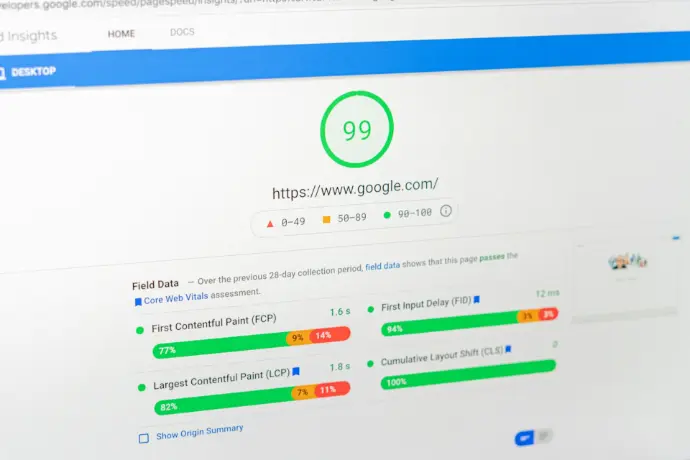
Pagespeed
With headless, every element of the website can be optimized so that high performance is within reach.
GraphQL
Efficient communication with Odoo by using GraphQL.
Redis in-memory caching
By using Redis, pages are served to the user at lightning speed from RAM.